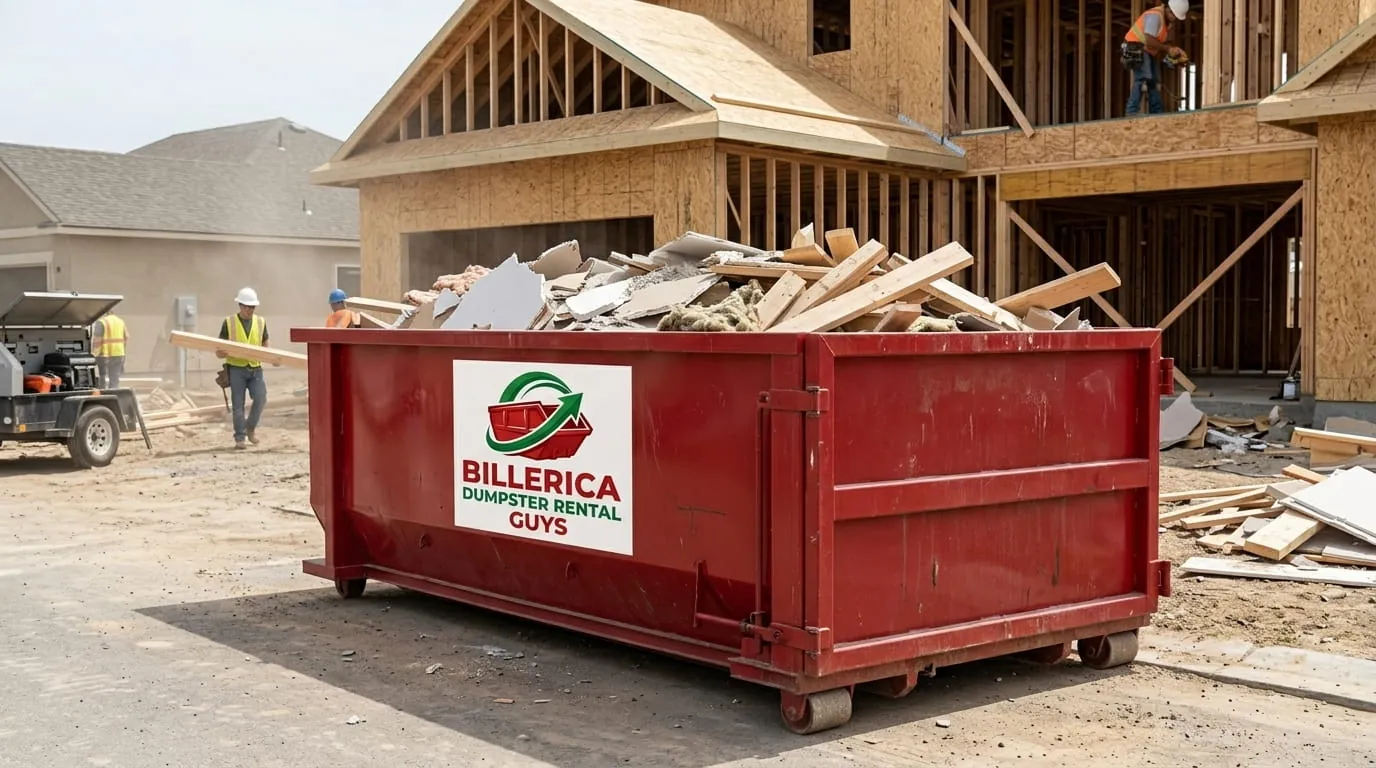
I have set thousands of roll-off boxes down on driveways all over Billerica, Tewksbury, Chelmsford, and up into Lowell. Most drop-offs are boring, which is exactly how you want them. But every so often a homeowner calls a week later because there is a hairline crack near the garage, or a set of scuff marks where the box slid a few inches on delivery. Almost every one of those calls could have been avoided with about ten minutes of prep and a couple of pieces of wood.
So let me walk you through what actually happens to a driveway when a loaded dumpster sits on it, and how you keep yours in one piece.
Why a roll-off is harder on your driveway than you think
An empty 20-yard container weighs somewhere around 4,000 to 6,000 pounds before you throw a single shingle in it. Fill it with a bathroom demo, some old plaster, a few yards of soil, and you are easily north of 10,000 pounds. Now here is the part people miss: that weight is not spread out evenly like a parked car. It is concentrated on a handful of small contact points.
A roll-off sits on two rear rails and a set of small wheels or castors near the back. When the truck winches it off the bed, the box drags and then drops onto those rear points. For a moment during delivery and pickup, most of the container's weight rides on maybe four square inches of steel. That is what puts a dent in soft asphalt or starts a crack in a slab that already had a weak spot.
Asphalt and concrete behave differently, too. Asphalt is a flexible pavement. On a hot Merrimack Valley July afternoon it softens, and a steel wheel will press right into it and leave a permanent divot. Concrete is rigid and strong in compression but weak in tension, so it does not dent, it cracks, usually along a line where the slab was already stressed or poorly supported underneath.
The single most useful thing you can do: put wood under it
If you remember nothing else from this article, remember this. Lay boards down under the load points before the box arrives, and keep them there the whole rental.
The idea is dead simple. You are taking those tiny steel contact points and spreading the load across a much larger footprint, so the pounds-per-square-inch that reach your driveway drop dramatically. This is the same reason snowshoes work. Same weight, more area, less sinking.
Here is what I tell homeowners to use:
- Two-by-tens or two-by-twelves run lengthwise where the rear rails and wheels will land. Solid dimensional lumber takes the point load better than a thin sheet.
- Three-quarter-inch plywood as a base layer under the boards if your surface is fragile, older, or freshly sealed. Half-inch will crack. Do not bother with anything thinner.
- Old scaffold planks if you have them. They are built for exactly this kind of abuse.
Skip the cheap stuff. Thin OSB, particleboard, or a couple of pallets will splinter under 10,000 pounds and do nothing. The wood needs enough thickness to actually bridge and distribute the load rather than just get crushed flat.
Position matters. The critical zone is the back third of the container, where the wheels and rear rails carry the most weight, and the spot where the box first touches down during delivery. Get your boards there. If you are not sure exactly where the wheels will sit, ask your driver when you book. A good one will tell you, or better yet, bring boards themselves.
Placement: where the box goes matters as much as what is under it
Half of driveway damage is really a placement problem. A few things I look for on every drop:
Set it straight and flat. A container on a side slope wants to twist, and all that torque concentrates on the downhill rail. If your driveway pitches hard toward the street, that is worth a conversation before delivery.
Keep it off the edges. The perimeter of a slab or an asphalt pad is the weakest part. There is less material supporting it and it is where cracks start. Center the box on the pad rather than hanging a wheel over the lip.
Mind the apron. The transition where your driveway meets the street or garage is often the thinnest, most beat-up section. I try never to park a loaded box straddling that seam.
Think about the truck, not just the box. The delivery truck itself is heavier than the container. If it has to drive up over a curb cut or a soft shoulder to line up the drop, that path takes load too. Clear a straight approach.
One more thing people forget: leave room to load it. If the box is jammed against the garage, you will be dragging heavy debris the long way around, and you are more likely to scrape the container against the house or scratch the driveway wrestling stuff in.
Not sure your driveway can take a full box? Call us before you book and describe it. We would rather spend two minutes on the phone than fix a crack later. Reach Billerica Dumpster Rental Guys at (978) 330-1722 and we will help you figure out the right size and the right spot. Our residential dumpster rental service is set up for exactly these home projects.
Older New England driveways and the freeze-thaw problem
Around here, driveways lead a hard life. A lot of the homes in Billerica and the surrounding towns were built decades ago, and plenty of driveways have been patched, resealed, and repatched more times than anyone can count. That history matters.
Freeze-thaw is the culprit. Water seeps into small cracks and pores in the pavement, freezes overnight, expands about nine percent, and pries the crack a little wider. Thaw the next afternoon, refreeze that night, and repeat all winter. By spring, a hairline crack has become a real one, and the base underneath may have heaved and settled unevenly. We get dozens of these freeze-thaw cycles every Merrimack Valley winter.
What that means for a dumpster: an older driveway may look fine on the surface but have voids and weak spots under it where the base has shifted. Put a concentrated 10,000-pound load over a void and the slab has nothing to push back against. That is when it cracks. So on an older driveway, I lean toward more wood, not less, and I am pickier about placement. If you have visible cracks, spalling concrete, or areas that already sound hollow when you walk them, tell your hauler. That is a good driveway for a smaller box you empty and swap rather than one giant container sitting full for two weeks.
Avoiding scratches, scuffs, and slide marks
Cracks are the big fear, but the more common complaint is cosmetic: scratches and black scuff marks where steel touched pavement. These come from two places.
First, delivery and pickup. As the box rolls off the truck bed, the rear wheels drag before they roll. On a freshly sealed asphalt driveway, that drag can leave marks. Boards under the landing zone fix most of this because the wood takes the drag instead of your pavement.
Second, loading. When you slide a heavy, sharp object like a cast-iron tub or a busted appliance up against the container and it shifts, the box can scrape sideways. Keep the container on its wood and it will not walk.
If your driveway was sealed in the last month or so, mention it. Fresh sealer is soft and marks easily, and it is worth being extra careful, or waiting a couple of weeks if the timing is flexible.
What a good hauler does without being asked
You should not have to manage all of this yourself. When we drop a box, here is what happens by default, and it is a fair standard to hold any company to:
- The driver asks where you want it and looks at the surface before dropping, instead of just backing in and dumping the box wherever.
- We carry and place boards under the load points, especially on residential driveways, as a matter of routine.
- We set the box gently, easing it down rather than letting it slam, which is where a lot of impact damage comes from.
- We talk through slope, aprons, and soft spots if the driveway looks marginal, and offer a lawn or street placement if that is safer.
- On pickup we check the surface and pull the box straight, not at an angle that drags a wheel across your pavement.
If a company shrugs when you ask about driveway protection, that tells you something. We built a whole driveway protection approach into how we run drops because we live and work in these towns and we do not want to be the reason your driveway needs redoing.
A simple pre-delivery checklist
Ten minutes the day before delivery saves you a headache:
- Pick the flattest, most central spot on the driveway and clear it.
- Lay down two-by-tens or plywood where the back of the box will sit.
- Clear a straight path for the truck, no low branches or tight turns.
- Note any existing cracks, sealed areas, or soft spots and tell the driver.
- Confirm the container size fits your project so you are not overloading or re-renting.
That is really the whole game. Spread the load, place it smart, respect an older driveway, and work with a hauler who treats your property like it is theirs. Do those things and the box comes and goes and your driveway never knows the difference.
Got a project coming up and want a second opinion on placement or sizing? Get in touch or call (978) 330-1722. We are local, we know these driveways, and we would rather set it up right the first time.

Founder, Billerica Dumpster Rental Guys — sharing straight advice from more than 15 years of local hauling experience.