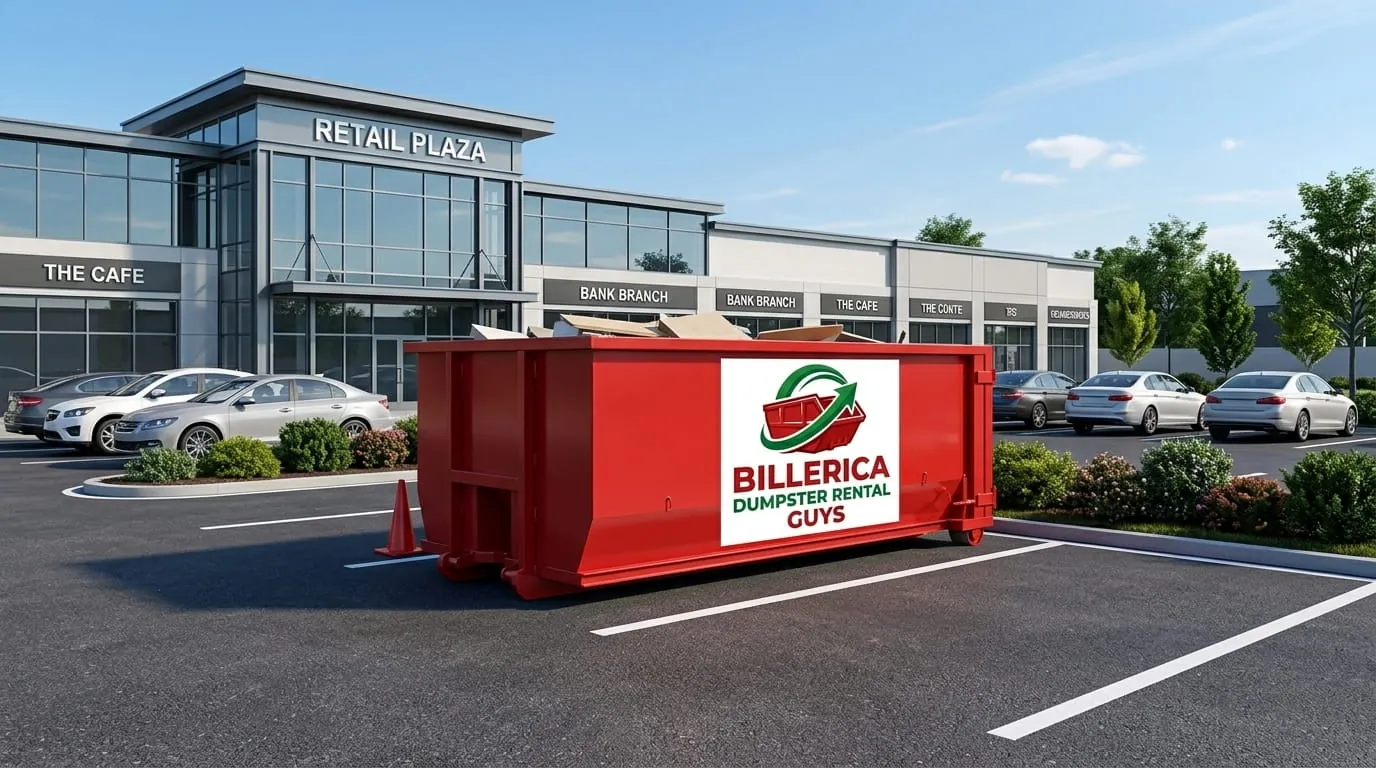
There's a moment on every roofing job that catches homeowners off guard. The crew rips into the first section, and instead of the light, papery debris they pictured, a wheelbarrow load of shingle comes off that two people have to muscle into the container. Old asphalt shingle is dense. Wet asphalt shingle is worse. And on a lot of the homes we service around Billerica and up through the Merrimack Valley, there isn't just one layer up there — there are two or three, stacked on top of each other across thirty or forty years of "we'll just go over it."
Getting the dumpster right for a tear-off is almost entirely a weight problem, not a volume problem. That's the thing people miss. You can have a container that looks half empty and still be over the legal road weight for the truck that has to haul it. So let's walk through how a tear-off actually fills a can, run the shingle math the way a roofer should, and land on the size that fits the vast majority of New England roofs.
Why roofing debris is so much heavier than it looks
A roofing "square" is 100 square feet of roof surface. That's the unit everything in this trade is measured in — material orders, labor bids, tear-off estimates. A typical single-family roof around here runs 18 to 30 squares depending on the footprint and how many gables, dormers, and valleys are cut into it.
Now the weight. A single layer of standard three-tab asphalt shingle weighs roughly 220 to 250 pounds per square once it's off the roof. Architectural or "dimensional" shingles — the thicker laminated kind that have been standard for the last couple decades — run heavier, closer to 350 to 400 pounds per square. Add the felt underlayment, old flashing, a few rows of ridge cap, and the nails, and it adds up fast.
Here's the math in plain numbers. Say you've got a 24-square roof with a single layer of architectural shingle:
- 24 squares × 375 lbs = 9,000 lbs, or about 4.5 tons
- Add underlayment and misc: call it 5 tons even
That's one layer. The container isn't full — not close. Asphalt shingle is dense and it stacks flat, so 5 tons of it might only take up 8 or 9 cubic yards of space. But 5 tons is a real number that the hauling truck's axles have to carry, and it's why roofing containers are priced and loaded by weight, not by how high the pile gets.
The multi-layer problem on older New England homes
This is where Billerica, Chelmsford, Tewksbury, and the older Lowell-area neighborhoods get interesting. A house built in the 1950s or 60s has very likely been re-roofed by going right over the existing shingle at least once, sometimes twice. Code allows two layers in a lot of situations, and plenty of homes have a third that shouldn't be there. You don't always know until the crew is up on the deck and the tear-off begins.
Multiply the weight math by the number of layers and the picture changes in a hurry. That same 24-square roof, if it's carrying three layers instead of one:
- Roughly 3 × 5 tons = 15 tons of debris
Fifteen tons is a serious load. No single standard roll-off is going to legally haul that in one trip, which means a multi-layer tear-off is often a two-container or a swap-out job, not a one-and-done. This is the single biggest reason we ask, before we drop anything, how old the house is and whether anyone knows how many layers are up there. If the answer is "no idea," we plan for the heavier scenario. It's a lot cheaper to have capacity you didn't need than to have a crew standing around a full can at 2pm with half the roof still to go.
One tell: if you can see the drip edge and the shingle is sitting noticeably proud of the fascia, or the rake edges look thick and lumpy, there's probably more than one layer. A crew that's done a few Merrimack Valley roofs can usually eyeball it.
The 10 to 15 yard sweet spot
Here's the counterintuitive part for anyone used to renovation debris. For a roofing tear-off, you almost never want the big 20 or 30 yard container, even on a large roof. Because shingle is so heavy, a 30 yard can loaded with asphalt would be wildly over legal road weight long before it looked full. You'd be paying for volume you physically cannot use.
The right tool is a smaller, heavier-rated container. A 10 yard roll-off is the workhorse for most single-layer residential tear-offs — it's built to take the density, it sits low so debris can be pitched or slid right in, and it hauls legally when it's loaded with dense material. For bigger roofs, roofs with a couple of layers, or jobs where the crew wants to keep momentum without a mid-day swap, the 15 yard dumpster is the more forgiving choice. It gives you a bit more room and margin while staying within weight limits for a typical shingle load.
Rough guide for planning:
- Under 20 squares, single layer: 10 yard is plenty
- 20–30 squares, single layer: 15 yard, or a 10 with room to spare
- Any roof, two layers: 15 yard, and budget for a possible swap
- Three layers or a big cut-up roof: plan two containers or a scheduled swap from the start
If you're not sure which side of the line your roof falls on, that's exactly the kind of thing worth a two-minute phone call before the job. We'd rather size it right up front than sort it out on the driveway. Call us at (978) 330-1722 and we'll walk through the roof with you.
We get into the specifics of container ratings and tonnage on our roofing dumpster rental page, but the short version is: for shingle, smaller and heavier-duty beats bigger every time.
Driveway placement that actually works for roofers
Where the container sits matters more on a roofing job than on almost any other. A tear-off crew is throwing debris off the edge of the roof, and every foot they have to carry a shovel of wet shingle is time and back strain. The ideal placement is tight against the house, directly below the largest continuous roof plane, so the crew can pitch material straight down into the can or run a debris chute into it.
A few things we think about when we spot a container for a roof job:
- Protect the driveway. We put boards down under the wheels and the loaded end. Roll-offs are heavy and asphalt driveways in summer heat can dent. This matters even more here because so many jobs run in the warm months.
- Clearance for the pitch. The container needs to sit where debris coming off the roof lands in it, not on the lawn, the AC condenser, or the neighbor's fence.
- Overhead lines. The delivery truck lifts the can high to set it down. Low power or cable lines over the driveway change where we can place it.
- Room to swap. If it's a multi-layer job that'll need a swap, we spot it where the truck can get back in and pull it without the crew having to move ladders and staging.
Good roofers already know this. If you're the homeowner coordinating between the roofer and us, the most useful thing you can do is ask your roofing crew where they want the can, then relay that. Nine times out of ten they have a spot in mind.
Scheduling swaps so the crew never stops
On a bigger tear-off, the container fills before the roof is done. When that happens, you don't want the crew climbing down and waiting. The move is a swap — we pull the full can and drop an empty in the same spot, ideally during a natural break in the work.
The key to a smooth swap is timing it against the tear-off, not against the clock. Most crews tear off in the morning while it's cool and dry, then dry-in and start laying new shingle in the afternoon. That morning tear-off is when the container fills. So if we know it's a two-can job, we line up the swap for late morning or midday, right as the first can tops out, so the empty is there before it becomes a bottleneck.
Two things make swaps painless: give us as much notice as you can — even a heads-up the day before that "this one's probably a swap" lets us route a truck efficiently — and keep the path to the container clear so the driver isn't waiting on ladders and material to be moved. A swap that's planned takes fifteen minutes. A swap that's a surprise can cost a crew an hour.
The bottom line for a tear-off
Roofing is a weight game. Size the container for the tonnage, not the pile height. Assume older Billerica-area homes may hide extra layers until the crew is up there. Reach for the 10 to 15 yard range rather than something bigger. Spot the can tight to the house on protected ground. And if it's a multi-layer roof, plan the swap before you need it instead of after.
If you've got a tear-off coming up and you're not sure how to size it, tell us the roof's rough square footage and how old the house is — we can usually nail down the right container in one call. Reach out through our contact page or call (978) 330-1722 and we'll get you set.

Founder, Billerica Dumpster Rental Guys — sharing straight advice from more than 15 years of local hauling experience.